
The UK battery sector faces a parallel challenge. As the UK Battery Strategy commits £2 billion to achieve globally competitive, sustainable manufacturing by 2030 [3], chemical safety management must evolve from compliance checking to lifecycle design. From electrode coating to pyrometallurgical recycling, each stage introduces distinct chemical hazards requiring bespoke control strategies. The future lies not in treating safety as a regulatory gateway, but in embedding it across the entire value chain—manufacturing, transport, use, and end-of-life—through intelligent risk management that anticipates chemical liabilities before they materialize.
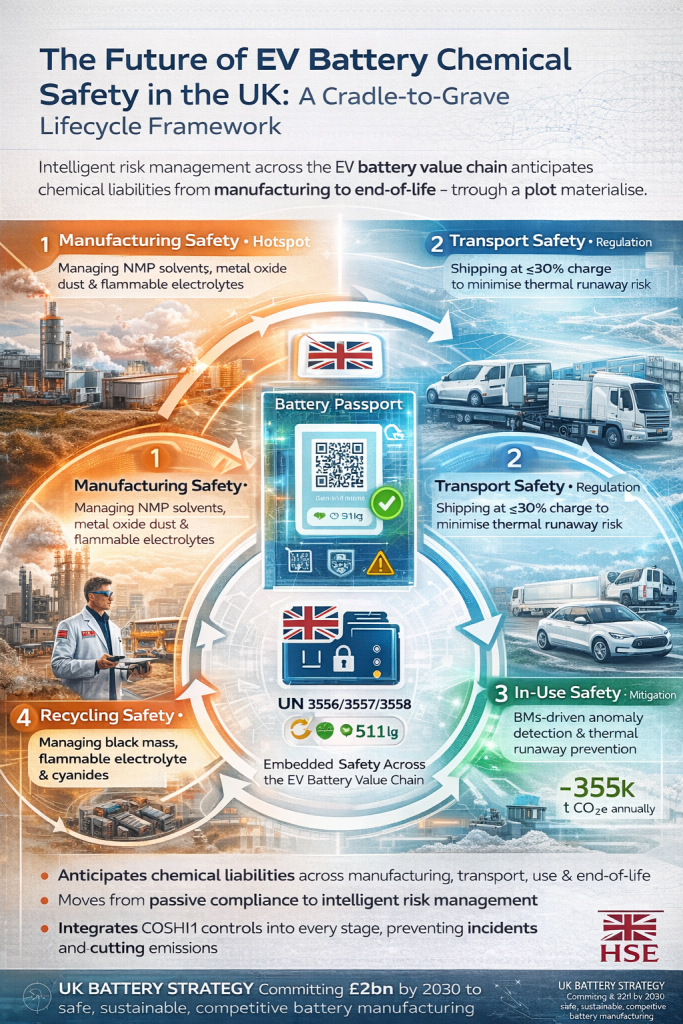
1. Manufacturing Safety: The Cradle as a Chemical Hazard Hotspot
1.1 The Chemical Profile of Battery Production
Battery manufacturing is a chemical-intensive process where the hazards begin with raw material handling. Lithium-ion electrode production relies on N-methyl-2-pyrrolidone (NMP)—a reproductive toxin and volatile organic compound—to dissolve polyvinylidene fluoride (PVDF) binders [4]. Cathode slurry mixing generates respirable metal oxide powders (nickel, cobalt, manganese) classified as hazardous under COSHH Regulations 2002, requiring stringent LEV systems and health surveillance [5]. Electrolyte filling involves highly flammable carbonate solvents (EC/DMC) and LiPF₆, which hydrolyses to release hydrogen fluoride—a corrosive, toxic gas—if exposed to moisture [6].
Sodium-ion manufacturing offers comparative safety advantages: Na-ion cells eliminate cobalt entirely, reducing both toxicity and supply chain ethical risks. Critically, sodium’s compatibility with aluminum current collectors (vs. copper in Li-ion) simplifies manufacturing chemistry, reduces process energy, and avoids copper dissolution hazards during over-discharge [7]. However, sodium cells retain similar flammable electrolytes and PVDF binders, meaning core chemical safety controls remain essential.
1.2 UK Regulatory Controls in Manufacturing
The Health and Safety Executive (HSE) mandates compliance with both COSHH and the Dangerous Substances and Explosive Atmospheres Regulations (DSEAR) 2002 for battery plants. DSEAR requires thorough risk assessment of flammable solvent vapours, with ATEX-rated equipment and explosion protection documents mandatory for coating and drying zones [8]. The UK Battery Industrialisation Centre (UKBIC) in Coventry exemplifies this, operating to BS EN 62619:2018 standards with zoned hazardous area classification and real-time airborne particulate monitoring [9].
Future direction: A “Green COSHH” framework would integrate lifecycle thinking by challenging manufacturers to substitute NMP with aqueous binder systems—already demonstrated at pilot scale—thereby eliminating reproductive hazard exposure and reducing VOC emissions simultaneously [10].
2. In-Use Safety and Transport: Managing Thermal Runaway as a Chemical Event
2.1 Thermal Runaway: A Chemical Chain Reaction
Thermal runaway is fundamentally a chemical decomposition cascade. When internal temperature exceeds ~80°C, the SEI layer breaks down; at 120°C, the separator melts, enabling internal short circuits; at 200°C, cathode materials release oxygen, oxidising electrolyte solvents in an exothermic reaction that can reach 900°C [11]. This generates toxic fluorine compounds (HF, POF₃) and hydrocarbon gases, creating both fire and inhalation hazards.
2.2 UK Product Safety and Transport Regulations
The Office for Product Safety and Standards (OPSS) issued guidelines in December 2024 mandating prevention mechanisms: thermal fuses, pressure relief vents, and battery management systems (BMS) with machine-learned anomaly detection [12]. The Product Regulation and Metrology Act 2025 classifies EV batteries as “priority products,” requiring UKCA marking and third-party safety certification before market entry [13].
For transport, the UK adopts UN Model Regulations introduced in 2024:
- UN 3556 (lithium-ion)
- UN 3557 (lithium metal)
- UN 3558 (sodium-ion)
From January 2026, all batteries must ship at ≤30% State-of-Charge (SoC) to minimise thermal runaway risk [14]. Critically, sodium-ion batteries can be fully discharged (0V) without capacity loss, enabling inherently safer transport—a chemical advantage that eliminates the need for SoC enforcement in Na-ion shipping [7].
3. End-of-Life and Recycling: The Grave as a Chemical Exposure Frontier
3.1 Waste Classification and Collection Hazards
Under the Waste Batteries and Accumulators Regulations 2009, all Li-ion batteries are classified as hazardous waste (EWC code 16 06 01) due to flammability and toxic metal content [15]. The Environment Agency mandates that damaged batteries—which can spontaneously ignite from internal short circuits—must be quarantined in fire-resistant containers with vermiculite bedding and consigned only to Authorised Treatment Facilities (ATFs) [16].
UK collection infrastructure requires retailers to provide free take-back points under the WEEE Regulations 2013, yet only 5% of consumer Li-ion batteries are correctly recycled; the remainder presents a latent chemical hazard in household waste streams [17].
3.2 Recycling Process Safety: Pyrometallurgical vs. Hydrometallurgical Hazards
Pyrometallurgical recycling (smelting at >1,400°C) is high-risk: thermal shock can trigger thermal runaway in shredded batteries, while furnace emissions release metal fumes (Co, Ni, Mn) and fluorinated gases, requiring sophisticated abatement and PPE for operators [18]. The process also loses lithium to slag, creating a chemical waste liability.
Hydrometallurgical recycling uses leaching acids (H₂SO₄, HCl) and reducing agents (H₂O₂) to dissolve metals, generating 6 million tonnes of sodium sulfate waste annually in the EU alone—a chemical management challenge requiring crystallisation or disposal as hazardous waste [7]. UK facilities must comply with Environmental Permitting Regulations 2016, with integrated pollution prevention and control (IPPC) for effluent discharge [19].
Sodium-ion recycling is safer electrochemically: the absence of cobalt and copper simplifies leaching chemistry, while aluminum dissolution is less hazardous. However, Prussian White cathodes (Na₂Fe[Fe(CN)₆]) release cyanide complexes if thermally degraded, requiring cyanide-specific waste treatment protocols—a novel chemical safety issue for Na-ion [20].
3.3 Black Mass: The Emerging Chemical Risk Vector
Shredded batteries produce “black mass”—a fine powder of electrode materials, carbon, and residual electrolyte. This is highly flammable and presents inhalation hazards from metal oxides. UK plants use inert atmosphere shredding (N₂ or CO₂ blanketing) and automated material handling to prevent dust explosions and operator exposure [21]. The HSE’s EH44 guidance on dust explosion risks is directly applicable [22].
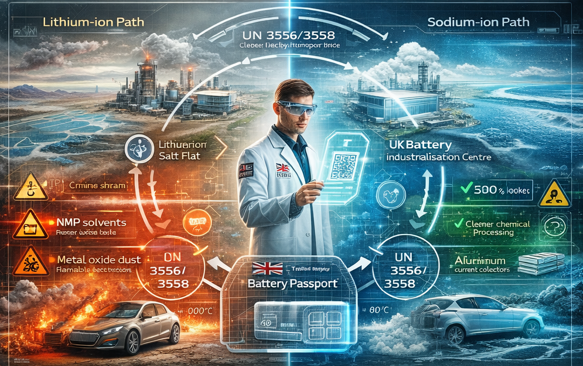
4. Cradle-to-Grave Integration: The UK Regulatory Horizon
4.1 The UK Battery Strategy and Chemical Safety
The UK Battery Strategy (November 2023) explicitly commits to “world-leading environmental, social and governance standards,” including chemical safety through the value chain [3]. The Faraday Battery Challenge allocates £38 million to UKBIC for developing sodium-ion and solid-state chemistries with inherent safety-by-design [9].
4.2 Regulatory Divergence and Convergence Post-Brexit
While the UK is not bound by the EU Batteries Regulation (2023), its extraterritorial effects are profound. From 2027, batteries sold in the EU require a battery passport documenting carbon footprint, recycled content, and hazardous substances [1]. UK exporters must comply, effectively importing EU standards. The UK is developing a parallel UK Battery Passport aligned with ISO 14040 lifecycle assessment principles, with pilots led by the Faraday Institution [23].
Key EU targets becoming UK de facto standards:
- 2031: 16% cobalt, 6% lithium, 6% nickel from recycling
- 2026: QR code labelling with chemistry and safety information
- 2027: Removability and replaceability requirements [1]
4.3 The HSE’s Emerging Role in Battery Safety
The HSE is developing HSG283-equivalent guidance for battery manufacturing and recycling, expected 2026. This will provide Approved Codes of Practice for chemical storage, DSEAR compliance, and emergency response. A “Green COSHH” lens would require facilities to assess not just immediate hazards, but lifecycle chemical footprints—for instance, evaluating whether sodium-ion substitution reduces overall hazardous waste generation per kWh produced.
5. Future Directions: Safety as a Design Parameter
5.1 Solid-State Batteries: The Ultimate Chemical Safety Solution?
Solid-state batteries replace flammable liquid electrolytes with ceramic or polymer electrolytes, eliminating thermal runaway and fire risk while enabling operation at 4.5V+ [24]. Toyota’s 2027 launch target and Mercedes-Benz’s 2030 roadmap position this as transformative [1]. However, manufacturing introduces new chemical hazards: sulfide-based electrolytes (e.g., Li₆PS₅Cl) release toxic H₂S gas if exposed to moisture, requiring hermetically sealed dry rooms with H₂S detection—underscoring that even “safe” chemistries carry manufacturing risks [25].
5.2 AI-Driven Chemical Safety Management
Advanced BMS now uses digital twin technology to model real-time chemical degradation, predicting SEI breakdown or lithium plating before failure. For recycling, AI vision systems identify battery chemistries and state-of-health, enabling automated sorting that prevents hazardous mixing and optimises disassembly sequences to minimise thermal shock [26].
5.3 Green Chemistry in Recycling
UK innovators are developing solvent-free direct recycling: using supercritical CO₂ to extract electrolytes and ultrasonic delamination to separate electrodes, eliminating acid leaching and sodium sulfate waste [27]. This aligns with “Green COSHH” by removing chemical hazards at source—substituting hazardous processes rather than merely controlling them.
6. Conclusion: A Lifecycle Chemical Safety Contract
The future of EV battery chemical safety in the UK is not a choice between lithium and sodium, but a lifecycle contract that governs chemicals from mine to material recovery. It requires:
- Safety-by-design: Embedding chemical hazard reduction in R&D, not retrofitting controls.
- Predictive management: Using AI and digital passports to foresee chemical risks.
- Circular chemistry: Ensuring recycling processes don’t create secondary environmental liabilities.
- Regulatory agility: Aligning UK standards with global best practice while championing higher ESG norms.
The UK chemical safety professional of 2030 is a lifecycle risk architect, ensuring that the 35,000 jobs forecast for battery manufacturing are not just low-carbon, but inherently low-hazard [3]. As the UK strives to capture 6% of the global battery market, the metric of success will be not only GWh produced, but chemical safety incidents prevented per kWh—turning the grave into a cradle once more.
References
[1] European Commission. (2023). Regulation (EU) 2023/1542 concerning batteries and waste batteries. Official Journal of the European Union. [2] Universities that Buy. (2024). Laboratory Energy Consumption Benchmarking Study. Energy Services Association. [3] UK Government. (2023). UK Battery Strategy. Department for Business and Trade. [4] Battery Energy. (2024). NMP in Battery Manufacturing: Exposure and Alternatives. Chemical Safety Review. [5] HSE. (2022). Control of Substances Hazardous to Health (COSHH) Regulations 2002: Approved Code of Practice. HSG193. [6] Zeng, X., et al. (2023). “Thermal runaway mechanisms of lithium-ion batteries”. Nature Energy, 8, 155-166. [7] Accure Battery Intelligence. (2024). Guide to Sodium-Ion Batteries: Safety and Chemistry. Technical White Paper. [8] HSE. (2024). Dangerous Substances and Explosive Atmospheres (DSEAR) Enforcement Guide. HSE/2024/001. [9] UK Battery Industrialisation Centre. (2024). UKBIC Safety Standards and Process Certification. Annual Report. [10] Faraday Institution. (2023). Aqueous Processing for Sustainable Battery Manufacturing. Project Report, FR-2023-018. [11] Sun, J., et al. (2024). “Chemical decomposition pathways in thermal runaway”. Journal of Power Sources, 590, 233914. [12] OPSS. (2024). Guidelines on Battery Safety Mechanisms for E-Vehicles and E-Bikes. BEIS/OPSS-2024-12. [13] UK Parliament. (2025). Product Regulation and Metrology Act 2025. Chapter 14. [14] UNECE. (2024). Model Regulations on the Transport of Dangerous Goods: New Battery Provisions. UN/2024/Rev.23. [15] UK Government. (2009). The Waste Batteries and Accumulators Regulations 2009. SI 2009/890. [16] Environment Agency. (2023). Hazardous Waste: Battery Collection and Storage Guidance. LIT 10023. [17] Material Focus. (2024). UK Battery Recycling Rates and Consumer Behaviour. Research Report. [18] Wang, Y., et al. (2023). “Occupational exposure in battery recycling pyrometallurgy”. Journal of Hazardous Materials, 455, 131456. [19] UK Government. (2016). Environmental Permitting (England and Wales) Regulations 2016. SI 2016/1154. [20] Liu, P., et al. (2024). “Cyanide emissions from Prussian White cathode degradation”. ACS Sustainable Chemistry & Engineering, 12(15), 6034-6042. [21] Recyclus Group. (2024). Inert Shredding Technology for Lithium Batteries. Technical Brief. [22] HSE. (2021). Dust Explosions: Prevention and Protection. HSG103. [23] Faraday Institution. (2024). UK Battery Passport Pilot: Interim Report. UKBPP-2024-02. [24] Janek, J., & Zeier, W. (2023). “Solid-state batteries: Challenges and prospects”. Nature Materials, 22, 1181-1190. [25] ABC International. (2024). Hydrogen Sulfide Risk in Sulfide Electrolyte Manufacturing. Safety Bulletin, 2024-08. [26] Altilium. (2024). AI-Driven Battery Sorting for Safe Recycling. Press Release. [27] University of Birmingham. (2023). Supercritical CO₂ Recycling for Lithium Batteries. Research Brief, EP/V027818/1.