The Peptide Question
Peptides are not an emerging biotechnology category. They are the operating layer of biology itself.
Every signal that travels between two cells, every enzyme that catalyses metabolism, every structural fibre that holds tissue together — all are peptides, or chains of peptides folded into proteins. The genome encodes peptides. Hormones are peptides. Antibodies are peptides. The fastest-growing class of approved pharmaceuticals over the past decade — semaglutide, tirzepatide, the GLP-1 family transforming the treatment of obesity and type-2 diabetes — are peptides. Approximately 80 therapeutic peptides are now FDA-approved, with a global market crossing $50 billion and growing at double-digit CAGR.
The substrate is universal. The question is where it comes from.
The Human Dependency
Humans cannot synthesise 9 of the 20 standard proteinogenic amino acids. We are obligate consumers of complete protein — we must ingest the building blocks our own biochemistry cannot construct, and assemble them into our own peptides post hoc. Evolution wrote this dependency into our architecture. The expensive tissue hypothesis (Aiello & Wheeler, Current Anthropology 36, 199, 1995) argues that human brain expansion was only possible because dense, easily digestible animal protein and fat freed our species from the metabolic cost of maintaining a large gut. Cooking — Wrangham’s Catching Fire hypothesis — extended this further. We became, in a structural sense, a species engineered around access to concentrated protein.
The Evolutionary Contract and Its Cost
That contract operated within ecological bounds for most of human history. It does not operate within them now.
Modern animal protein production accounts for approximately 14.5% of anthropogenic greenhouse-gas emissions (Gerber et al., FAO 2013), occupies the largest share of global agricultural land, and consumes orders of magnitude more freshwater per kilogram of digestible protein delivered than its plant or microbial alternatives. A kilogram of beef carries, on a mass-balance basis, roughly 6 kg of feed input, 15,000 L of water, and 100 kg CO₂e. Industrial livestock is also the principal driver of antibiotic resistance, zoonotic emergence risk, and a substantial fraction of biodiversity loss.
This is not a moral argument. It is a thermodynamic one. The species cannot continue to deliver complete protein and bioactive peptides to nine billion people via an industrial system whose externalities now scale faster than the system itself.
What Peptides Actually Do — Beyond Their Structural Role
Short bioactive peptides modulate physiology directly when consumed or administered. The peer-reviewed literature documents:
- Cardiovascular: ACE-inhibitory peptides from milk, fish, and marine sources, with measurable effects on blood pressure
- Metabolic: DPP-IV inhibitory peptides relevant to glucose regulation; GLP-1 receptor agonists transforming obesity treatment
- Antimicrobial: defensins, cathelicidins, and bacteriocins active against drug-resistant pathogens
- Antioxidant: hydrolysate fractions that scavenge reactive oxygen species
- Immunomodulatory: peptide signals interacting with innate-immune receptors
- Gut–brain axis: opioid-like casomorphins, satiety-modulating fish-derived peptides
- Therapeutic pharmacopoeia: insulin, oxytocin, octreotide, semaglutide, tirzepatide — all peptides
The same peptide category therefore spans three distinct economic surfaces: commodity protein (food), functional ingredient (nutraceutical, cosmeceutical), and regulated therapeutic (pharmaceutical). The same molecule, characterised and produced to different standards, sells at one-to-three orders of magnitude apart.
The Forward Question
If we accept the evolutionary fact that humans require complete protein and benefit from bioactive peptides, and we accept the thermodynamic fact that the current production system is incompatible with planetary limits, the question is no longer whether we deliver peptides at population scale — it is from where.
CAL-PEP positions three convergent answers, each addressing a different aspect of the supply problem:
- Recover — bioactive peptides already exist, unrecognised, in the waste streams of existing protein production.
- Manufacture — microorganisms synthesise peptides at resource efficiencies no animal can approach.
- Cultivate — Microbial couple atmospheric carbon and atmospheric nitrogen into peptide bonds using a mechanism no industrial process matches.
The three pathways are not in competition. A protein-and-peptide-secure future probably uses all three in parallel, sized to their respective comparative advantages.
— Fish Waste Valorization
The problem
Scotland’s seafood processing sector generates an estimated 40–60% of landed fish mass as low-value by-product: heads, frames, viscera, skin, fins, off-cuts. Globally the equivalent stream runs into tens of millions of tonnes annually. Almost all of it is currently routed to fishmeal, low-grade fertiliser, or landfill. The biological value embedded in these streams is destroyed in the strict thermodynamic sense — energy, nitrogen, and characterised peptide sequences are degraded back to commodity-grade fractions or lost entirely.
What is actually in the by-product
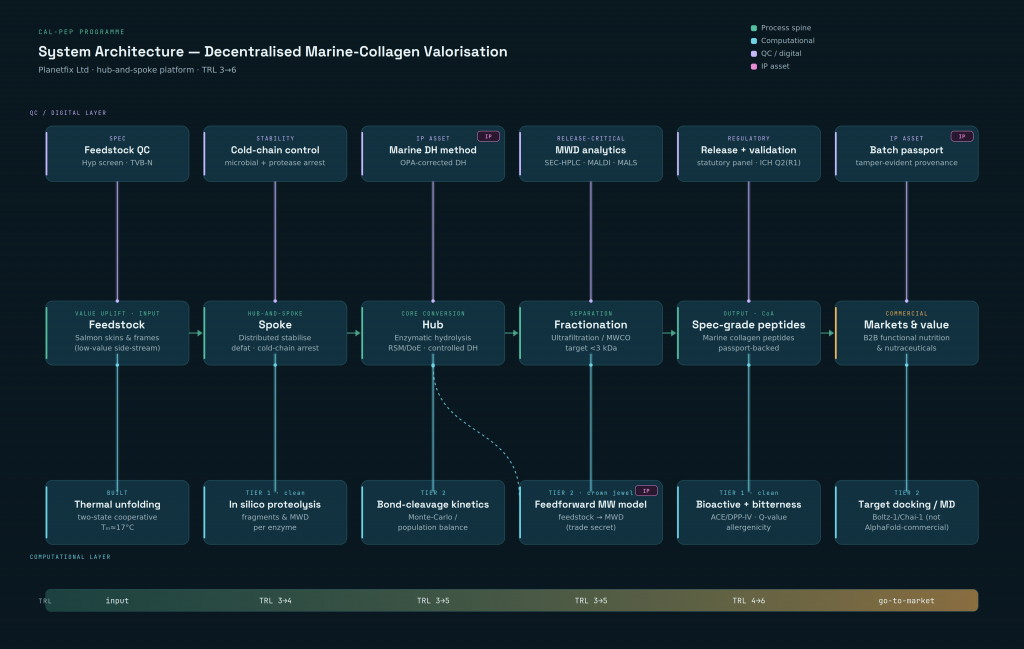
Fish processing waste is enriched in type I collagen (skin, scales), gelatin (extractable from bone and skin via controlled thermal hydrolysis), and proteins whose enzymatic hydrolysates carry documented bioactivity. Published activities from marine peptide fractions include ACE inhibition (anti-hypertensive), DPP-IV inhibition (anti-diabetic), antioxidant activity, antimicrobial activity against ESKAPE-class pathogens, and immunomodulation. Marine collagen-derived peptides, in particular, have an established cosmeceutical market.
The extraction mechanism
Selective enzymatic hydrolysis with food-grade proteases — Alcalase, Protamex, Flavourzyme, papain, or rational combinations — cleaves protein backbones at defined sites. The degree of hydrolysis, the pH, the temperature, the enzyme-to-substrate ratio, and the reaction time jointly determine which peptide populations are produced. Downstream ultrafiltration, ion-exchange chromatography, and reverse-phase HPLC fractionate the hydrolysates by molecular weight, charge, and hydrophobicity into characterised peptide pools, with bioactivity confirmed by in vitro assay before any clinical or regulatory pathway begins.
The CAL-PEP contribution
A regional circular pathway converting Scottish seafood by-product into characterised, traceable, marine-sourced peptide ingredients for nutraceutical, cosmeceutical, and — where regulatory and clinical evidence support it — therapeutic markets. The unit economics shift from commodity protein at ~£1–2 per kg to characterised bioactive ingredients at ~£50–1,000+ per kg, contingent on the regulatory classification chosen per target market.