
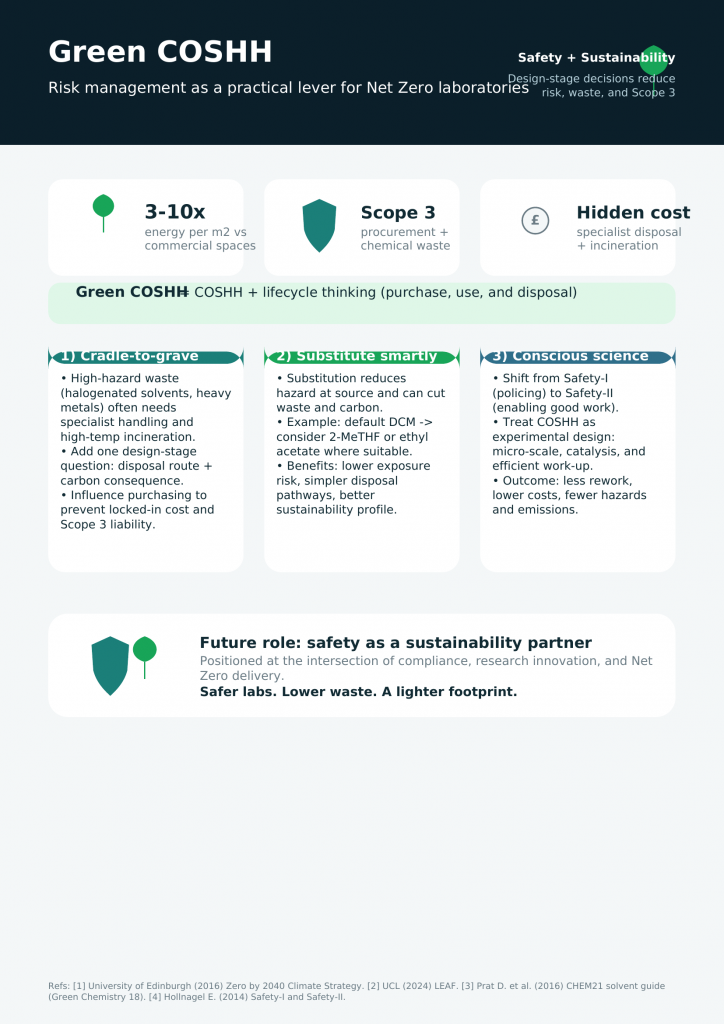
Universities, research institutes and the Industries are leading the global push toward Net Zero targets. Yet scientific research remains inherently resource-intensive. Laboratories can consume 3 to 10 times more energy per square metre than commercial spaces [1, 2], and chemical procurement and waste streams can contribute significantly to an institution’s Scope 3 emissions [2].

The future of chemical risk management must evolve beyond traditional boundaries. It should protect people and reduce environmental harm by influencing decisions earlier—at experimental design and purchasing, not just at the point of use. By moving from standard regulatory assessments to a “Green COSHH” framework—COSHH informed by lifecycle thinking—institutions can simultaneously improve safety, sustainability, and cost efficiency.
Intelligent risk management emerges as the critical lever for unlocking Net Zero in the laboratory.
1) The cradle-to-grave cost of compliance
In conventional safety management, thought often stops at the experiment’s conclusion and the bottling of waste. For institutions, this marks where hidden costs begin.
Disposing of high-hazard waste—particularly halogenated solvents or heavy metals—frequently requires specialist handling and high-temperature incineration. This route carries substantial financial expense and carbon footprint.
A “Green COSHH” approach embeds lifecycle assessment (LCA) thinking into the risk assessment process. Before ordering a chemical, researchers should be asking an additional question: what is the disposal route and carbon consequence of the waste about to be generated?
When safety management systems influence choices at the purchasing stage, the benefits extend beyond immediate risk reduction. Downstream carbon liability shrinks, hazardous waste streams contract, and locked-in costs are avoided before the solvent reaches the bench.
2) Substitution as the intersection of safety and sustainability
The Hierarchy of Controls places substitution near the top—just below elimination—because it removes hazards at source. Historically, substitution focused on lowering toxicity. Today, it addresses toxicity while simultaneously reducing carbon and waste burdens.
Solvent choice provides the clearest example. Industry tools such as the CHEM21 Solvent Selection Guide map problematic solvents against greener alternatives [3].
Conventional approach: a researcher uses DCM because “that’s what the paper said.” It is a suspected carcinogen, volatile, and often requires segregated disposal.
The Green COSHH approach: safety management processes challenge defaults and suggest alternatives such as 2-MeTHF or ethyl acetate, where appropriate.
The value is immediate and multi-dimensional:
Safety: reduced toxicity and exposure risk for laboratory staff.
Sustainability: improved environmental profile, and in some cases access to bio-derived supply routes.
Cost and carbon: less burdensome waste classification and disposal pathways.
This demonstrates where safety management functions add strategic value. The chemical literacy exists to support researchers in making substitutions that are safer for people and aligned with institutional Net Zero plans.
3) From compliance to conscious science
Delivering this shift requires culture change: moving from Safety-I (policing rules) to Safety-II (enabling good work) [4].
Researchers are rarely deliberately wasteful. More often, they are busy, constrained by precedent, or unaware of viable alternatives. COSHH can become a paperwork hurdle—something completed after decisions are made.
“Green COSHH” reframes assessment as part of experimental design. When safety management teams collaborate with research teams, conversations should extend beyond goggles and signage to include efficiency and impact:
- Can reactions be micro-scaled? Smaller scale reduces risk magnitude and waste volume.
- Can catalytic routes be employed? Catalysis can reduce material intensity and energy demand.
- Can work-up or solvent systems be redesigned? Often the biggest waste sits in extraction, washing, and purification.
Implemented effectively, this approach does not slow research—it improves it. It reduces rework, lowers costs, and enables good science with fewer hazards and emissions.
The future role
Safety management function of the future is not merely regulatory. The role evolves into a sustainability partnership and design-stage enablement.
This position sits at the intersection of three strategic priorities: regulatory compliance, research innovation, and Net Zero delivery. By adopting a “Green COSHH” mindset, safety management helps ensure that cutting-edge research today does not become environmental liability tomorrow.
Safety is not only about going home safe at the end of the day. It is about ensuring there is a planet to go home to.
References & further reading
University of Edinburgh. (2016). Zero by 2040: The University of Edinburgh’s Climate Strategy. Department for Social Responsibility and Sustainability.
UCL. (2024). Laboratory Efficiency Assessment Framework (LEAF). Sustainable UCL.
Prat, D., et al. (2016). “CHEM21 selection guide of classical- and less classical-solvents”. Green Chemistry, 18, 288–296. Royal Society of Chemistry.
Hollnagel, E. (2014). Safety-I and Safety-II: The Past and Future of Safety Management. Ashgate Publishing.
Anastas, P. T., & Warner, J. C. (1998). Green Chemistry: Theory and Practice. Oxford University Press.