
When you think of “superfoods,” you might picture exotic berries or rare herbs. But one of the most powerful nutrient sources on the planet is far simpler: spirulina—a blue-green, photosynthetic microbe that’s been fueling people for centuries and is now central to conversations about sustainable nutrition and even space travel.

“S for Spirulina” by DanielaC173 (2017), via Flickr. Licensed under CC BY-SA 2.0 (https://creativecommons.org/licenses/by-sa/2.0/).
Spirulina (genus Arthrospira, especially A. platensis) is a filamentous cyanobacterium that thrives in alkaline lakes and in controlled cultivation systems. Long before it appeared in health stores, spirulina was harvested around Lake Texcoco by the Aztecs and made into “tecuitlatl,” and it remains part of traditional diets around Lake Chad today.
Why it stands out nutritionally
Spirulina’s profile is unusually dense for such a tiny organism:
- Protein-rich: roughly 60–70% protein (dry weight) with all essential amino acids.
- Vitamin & mineral support: B-vitamins, vitamin E, iron, magnesium, and more.
- Bioactives: pigments like phycocyanin and beta-carotene that act as antioxidants and help modulate inflammation.
For communities facing malnutrition or iron deficiency—especially women and children—spirulina can be incorporated into familiar foods (smoothies, baked goods, snack bars, pasta, beverages) as a digestible boost to daily intake.
Benefits at a glance
- Helps support immune function
- Contributes to energy and muscle maintenance (complete, plant-based protein)
- Provides antioxidant and anti-inflammatory compounds (notably phycocyanin)
From pond to powder
Modern spirulina production is straightforward but science-guided:
- Cultivation – Open raceway ponds or closed photobioreactors under controlled light, pH, and nutrients.
- Harvesting – Biomass is filtered once cultures reach target density.
- Drying – Low-temperature methods help preserve pigments and nutrients.
- Processing – The dried biomass becomes powder, tablets, capsules, or functional ingredients for foods and cosmetics.
A catalyst for community development
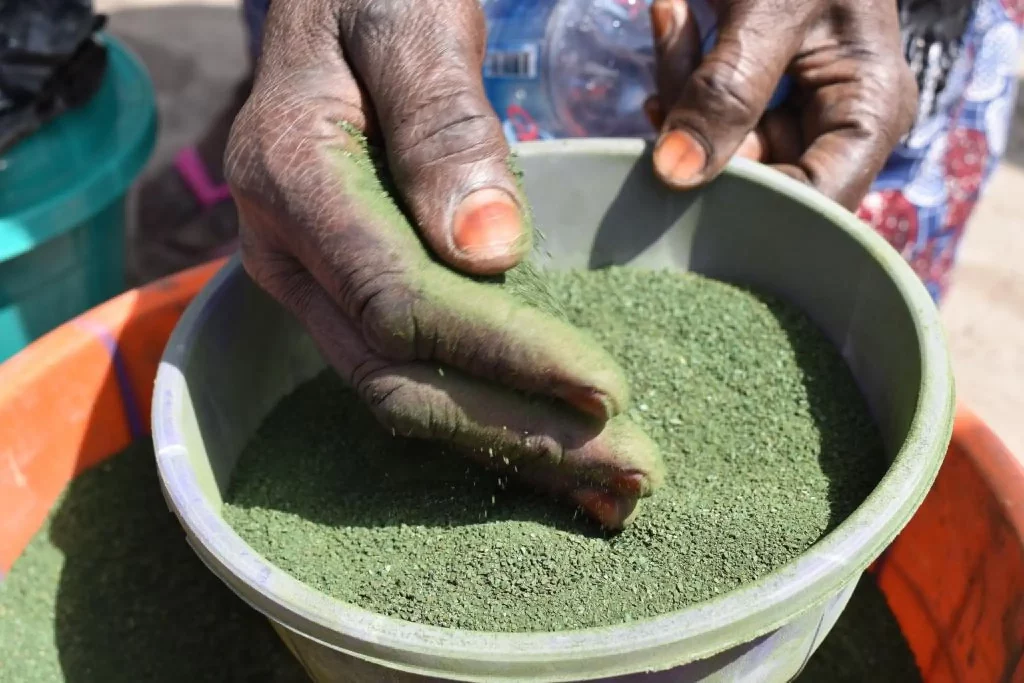
Women harvesting spirulina near Lake Chad. Photo: Denis Sassous / GCCA+, © European Union, CC BY 4.0.
Spirulina production can transform coastal fishing communities, where warm temperatures and saline conditions create ideal cultivation environments. Women in fishing communes can grow spirulina in small ponds while men are at sea, processing basic biomass and delivering it to a community-owned hub for final drying, milling, and quality control. This creates independent income streams while supplying affordable nutrition to schools, clinics, and shops—building on Lake Chad’s ancient dihé harvesting wisdom.
The beauty lies in scalability
The same network can evolve to meet international export standards through enhanced traceability, HACCP protocols, and contaminant testing. Coastal communities maintain ownership while accessing global markets, creating a sustainable bridge between local needs and worldwide demand.
Market momentum (and new frontiers)
Global demand is rising across supplements, functional foods, cosmetics, and animal nutrition. Analyst estimates vary, but many project a solid, sustained growth curve through 2032 as consumers and brands seek nutrient-dense, low-footprint ingredients. Meanwhile, spirulina’s efficiency and photosynthetic productivity have made it a testbed for closed-loop life-support systems—NASA and partner teams have studied it for producing oxygen and food on long-duration missions.
The bigger picture
From tackling micronutrient gaps to enabling circular, low-resource protein systems, spirulina shows how microscopic life can solve outsized problems. It even takes me back to Sid Meier’s Alpha Centauri, where cultivating algae wasn’t just strategy—it was survival. In both the game and the real world, algae remind us that resilience can start at the smallest scale.

References
Habib, M.A.B., Parvin, M., Huntington, T.C., & Hasan, M.R. (2008). A review on culture, production and use of spirulina as food for humans and feeds for domestic animals and fish. FAO Fisheries and Aquaculture Circular No. 1034. FAO.
Marjanović B. et al. Bioactive Compounds from Spirulina spp.—Nutritional and Functional Properties (2024).
Fernandes R. et al. Exploring the Benefits of Phycocyanin: From Spirulina to Biomedical Applications (2023).
Batello, C., Marzot, M., & Touré, A.H. (2004). The Future is an Ancient Lake: Traditional knowledge, biodiversity and genetic resources for food and agriculture in Lake Chad Basin ecosystems. FAO.
Market.us. (2024). Spirulina Market Report. Retrieved from https://market.us/report/spirulina-market/